

Our vision for Tamar Valley National Landscape is informed by the Forces for Change operating in our landscape. These have been reviewed after due consideration of the State of the National Landscape 2024 Report and the Natural England Natural Habitat Indicators.
The following list focuses on the primary forces of change, it is not exhaustive.
Policies
Section 85 of the Countryside and Rights of Way Act 2000 (CRoW Act), as amended by the Levelling-up and Regeneration Act in December 2023, requires relevant authorities to ‘seek to further the purpose of conserving and enhancing the natural beauty of the Area of Outstanding Natural Beauty’ in exercising or performing any function that affects designated AONBs in England (now called National Landscapes).
The Government’s Environment Improvement Plan (EIP) 2025 presents a roadmap for restoring England’s environment over the coming years. The plan sets out measurable commitments across every priority – from cleaner air and water to thriving wildlife and resilient landscapes. Defra’s Protected Landscapes Targets & Outcomes Framework establishes ambitious targets for National Parks and National Landscapes and sets out how we are to achieve 3 outcomes from the EIP: thriving plants and wildlife; mitigating and adapting to climate change; enhancing beauty, heritage and engagement with the natural environment.
Regulation for the Environmental Delivery Plans is also now in place following Royal Assent for the Planning and Infrastructure Act. This will allow Natural England to begin preparing an Environmental Delivery Plan (EDP), setting out the actions to be taken in a specified area to address the impact development has on a protected site or species. It also brings into force section 97 of the Act, which ‘makes provision for the creation of statutory instruments containing nature restoration levy regulations’.
Local Plans
A Ministerial Statement published in December indicated that the new plan-making system for England will commence in early 2026 and has committed to publish the enabling regulations imminently. This is likely to result in a formal plan-making timeframe between March/April 2026 and the beginning of 2029 for Local Plans relating to the TVNL.
The Local Plans will set out the strategic policies to guide development and growth across Devon and Cornwall over the next 20-25 years, ensuring that we meet housing, employment, infrastructure, nature recovery and environmental needs in a sustainable manner.
National Planning Policy Framework (NPPF) revision
The Government published a revised draft National Planning Policy Framework (NPPF) in December 2025 which was at consultation stage at the time of drafting this Management Plan. The policies are not yet in force, and the introduction of the changes is subject to a consultation that ends on 10 March 2026.
The new NPPF is very different from its predecessors and is expressed as a number of policies for plan-making and decision-making. From the time that it is published (in late March/April 2026) any policies of adopted Local Plans or Neighbourhood Plans that are “in any way inconsistent with the national decision-making policies” outlined in the NPPF should be given “very limited weight” in decision-making.
The draft Framework sets out revised guidance and decision-making policies for planning across England. It continues to assign the same high value and degree of protection to National Landscapes and stipulates that substantial weight should be placed on the importance of conserving and enhancing their natural beauty. It also confirms that the scale and extent of development in National Landscapes should be limited and sensitively located to avoid harm to their statutory purposes and special qualities. It continues to stipulate that major development will only be permitted in exceptional circumstances subject to a number of stringent tests, while development within the setting of National Landscapes should be sensitively located and designed to avoid or minimise adverse impacts on the designated areas.
The NPPF draft starts to articulate the role of the planning system in helping to deliver aspects of the Nature Recovery Strategies and addressing climate change. The new plan-making policies of the NPPF highlight the importance of using relevant environmental evidence, including Local Nature Recovery Strategies, to set out areas which need safeguarding from development because of their importance for nature; balancing the need to safeguard areas because of their potential for nature with the need to deliver development, pursue opportunities for nature recovery, and direct development away from sensitive locations. New provisions include requirements for plan-makers to set clear standards for green infrastructure, drawing upon national benchmarks.
The draft document may be viewed at:
National Planning Policy Framework: draft text for consultation.
A briefing note on the changes can be found at:
Briefing note – NPPF and other planning changes December 2025.
National Land Use Framework
The National Land Use Framework is due for publication early in 2026 and will inform development of the Spatial Development Strategies and Local Plans for Cornwall and Devon.
Local Government Reorganisation
Local Government Reorganisation in Devon may impact the Devon part of the Tamar Valley Management Plan area. The Government has invited district councils, Plymouth City Council, Torbay and Devon County Council to submit a proposal for reorganisation. All Devon authorities submitted the full Local Government Reorganisation proposal on the 28th November 2025. New unitary or unitaries would start in 2028/2029 to be confirmed.
Artificial intelligence and technological advancements
Artificial Intelligence and Machine Learning is accelerating change across sectors through adaptive intelligence with significant employment implications for many traditional jobs, requiring reskilling of workforce. Robotics and autonomous machinery (self-drive tractors) reducing need for manual labour; fewer seasonal and low-skilled jobs, with potential loss of traditional farming knowledge.
AI is also shaping how we monitor, protect and plan for resilient landscapes, enabling smarter stewardship, from satellite data to soil health – precision agriculture using AI to optimise irrigation, fertilisation and pest control.
Climate Change
Climate change is already reshaping the Tamar Valley. Since 1950, average temperatures have risen by 1.5°C, accompanied by increased rainfall and more sunshine hours. These shifts are driving a range of environmental impacts:
- Rising sea levels are threatening homes and heritage features along the river, while estuarine retreat and coastal erosion, up to 1.5 metres over the past 30 years, are altering the shape and character of the landscape.
- Flooding risk is increasing, which could lead to pressure for larger engineered defences with the potential to compromise the scenic and ecological qualities of the valley.
- Prolonged droughts are drying out heathland habitats, raising the risk of wildfires and stressing native flora and fauna.
- Air pollution hotspots (including CO₂, PM2.5, and SO₂) are emerging near settlements and traffic-heavy areas, affecting both human health and ecosystem resilience.
- Tree planting efforts face growing challenges from deer and grey squirrel browsing, limiting the success of woodland regeneration and carbon sequestration goals.
- Spring / summer droughts are also one of the significant challenges to establishing new tree planting.
- Invasive species, such as giant hogweed and Himalayan balsam, continue to spread, undermining native biodiversity and requiring ongoing management.
- Increased demand in renewable energy infrastructure, including wind turbines and solar panels, which will require sensitive integration to support climate resilience without compromising the valley’s distinctive landscape character.
Biodiversity Pressures
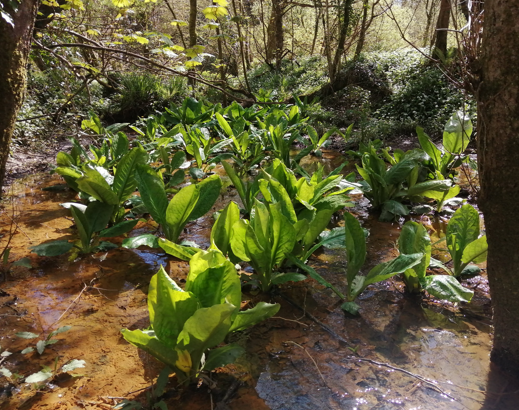
Nature in the Tamar Valley is under increasing pressure. The State of Nature Report 2023 revealed that nearly 1 in 6 species in Great Britain are threatened with extinction, while the Bugs Matter citizen science survey recorded a 63% decline in insect numbers between 2021 and 2024.
Only 45% of Sites of Special Scientific Interest (SSSI) features are in favourable condition, and currently none have improvement actions on track. Although priority habitats cover 19% of the area, data reliability varies, and habitat fragmentation continues to drive species decline, exacerbated by land use changes and climate pressures.
Tree diseases such as ash dieback and Phytophthora, alongside invasive species like Yellow-Legged hornet, Himalayan balsam, Japanese knotweed, and Pacific oysters, pose further threats to biodiversity.
There is a clear requirement to halt biodiversity loss, restore wildlife-rich habitats, and improve SSSI condition by 2042. This will depend on structural changes in agriculture and forestry, better water quality and management, and the adoption of nature-enhancing techniques across land use sectors.